AI teams are making a very expensive mistake: they use the best model for every task.
It sounds logical at first. If the model is smarter, the output should be better. If the output is better, the product should be better. If the product is better, users should be happier.
But that is not how AI products work.
In practice, using the strongest model everywhere often makes the product slower, more expensive, harder to scale, and not meaningfully better for the user. The issue is not the model. The issue is the decision-making around the model.
The Model Trap
Most teams treat AI model selection like a leaderboard. They ask, “What is the best model available?” Then they plug it into everything.
Customer support summaries. Internal tagging. Search queries. Content drafts. Data extraction. Classification. Personalization. Research. Decision support. Everything goes through the same expensive model because nobody wants to be the person who chose the “weaker” option.
This is where the cost starts to creep in. Not just financial cost, but operational cost, latency cost, product complexity, vendor dependency, scaling risk, and unclear value.
A stronger model does not automatically create a stronger product. Sometimes it only creates a more expensive workflow.
Not All AI Tasks Are Equal
AI tasks are not one category. They look similar from the outside because they all involve a prompt and a response, but underneath, they are very different jobs.
Some tasks need deep reasoning. Some need speed. Some need consistency. Some need creativity. Some need structure. Some need a cheap first pass. Some need a human in the loop. Some should not use a large model at all.
A founder may ask an AI system to “analyze customer feedback.” That sounds like one task. But inside the product, it may include cleaning raw text, detecting language, removing duplicates, classifying topics, identifying sentiment, grouping similar requests, summarizing patterns, generating recommendations, and writing an executive summary.
Each of these jobs has a different level of complexity. So why would we use the same model for all of them?
Where Teams Waste Money
The waste usually starts in small places. A team uses a premium model to clean text, classify categories, rewrite labels, summarize short snippets, and generate internal notes nobody reads.
Each call looks harmless on its own. A few cents here. A few seconds there. But product usage compounds. What feels acceptable during testing becomes painful in production.
The dashboard slows down. The monthly bill jumps. Margins shrink. The team starts adding limits. Users start waiting. Then the product team realizes the painful truth: they did not build an AI strategy. They built a dependency on the most expensive default.
The Right Question
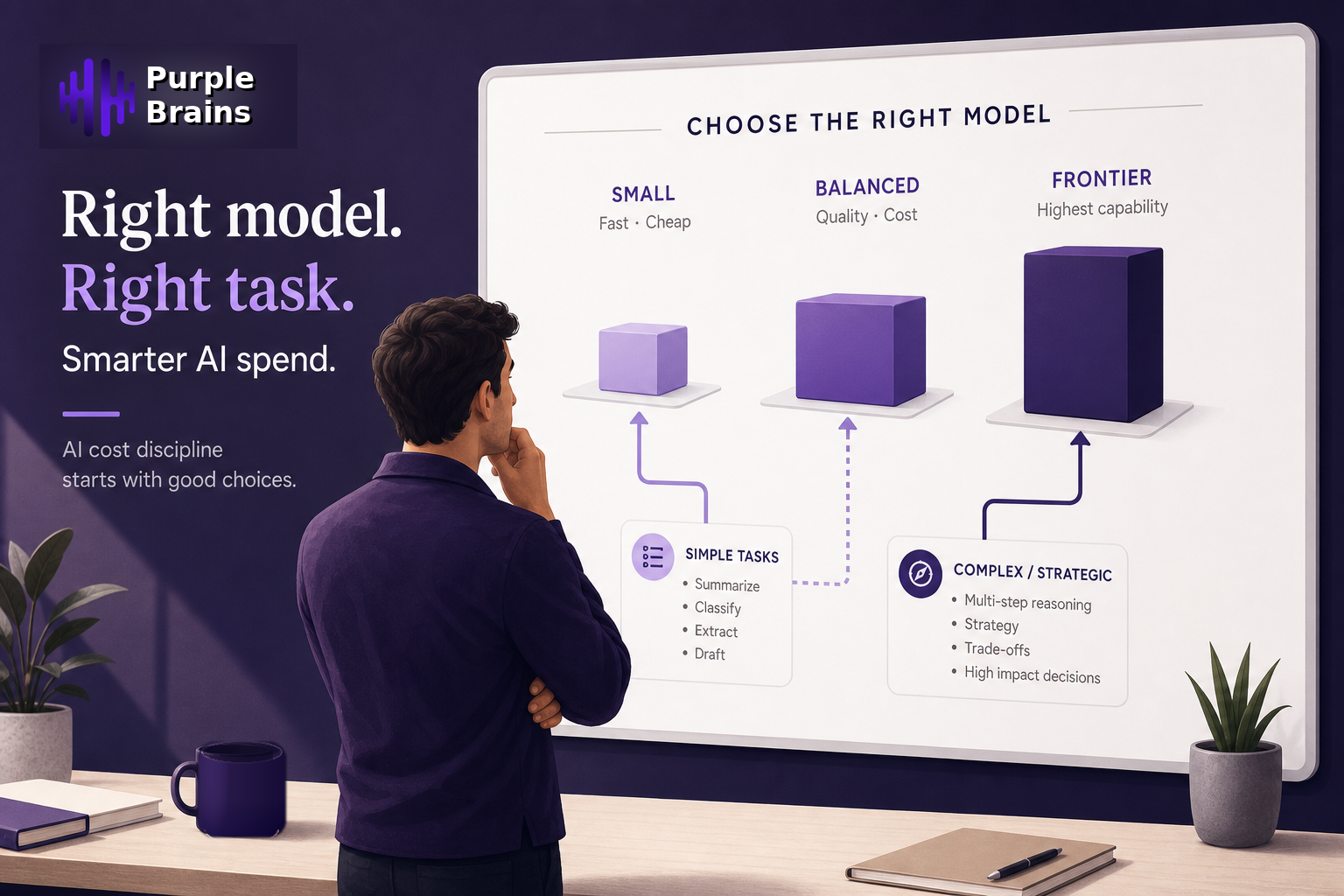
The right question is not, “What is the best model?” The right question is, “What is the right model for this job?”
That changes the conversation. For a simple classification task, a smaller model may be enough. For structured extraction, a cheaper model with a good schema may perform well. For summarizing short text, speed may matter more than depth. For high-stakes reasoning, the strongest model may be justified. For creative exploration, using multiple cheaper outputs may be better than one expensive answer. For repetitive workflows, rules, embeddings, or traditional software may be the better choice.
This is where product thinking matters. You do not choose technology in isolation. You choose it based on the job, the user need, the risk, the cost, and the product experience.
A Simple Way To Think About It
Before choosing a model, split the workflow into layers.
Low-risk tasks are tasks where mistakes are easy to catch or low impact. Examples include tagging, formatting, rewriting small text, grouping basic inputs, and extracting simple fields. Use cheaper models where possible. Measure accuracy. Improve prompts and schemas before upgrading the model.
Medium-risk tasks affect the user experience, but they are not final decisions. Examples include summarizing feedback, drafting replies, generating recommendations, ranking options, and preparing internal insights. Use a balanced model. Add evaluation. Compare outputs. Keep humans in the loop where needed.
High-risk tasks involve decisions, trust, money, compliance, or important user outcomes. Examples include medical interpretation, legal review, financial recommendations, strategic decisions, and complex reasoning. This is where stronger models make sense. But even here, the model should not work alone. You need guardrails, validation, traceability, and a product flow that handles uncertainty.
Better AI Products Are Designed, Not Prompted
The best AI products are not built by throwing the strongest model at every problem. They are designed around workflows.
They break the work into steps. They use the right level of intelligence at each step. They know when to use a model, when to use rules, when to use search, when to use memory, and when to ask a human.
This is not just an engineering decision. It is a product decision. The model affects pricing, margins, speed, reliability, user trust, scalability, support costs, and positioning.
A product that depends on an expensive model for every action may look impressive in a demo. But demos are not businesses. Production exposes weak decisions.
The Founder Mistake
Founders often overpay for AI because they want to reduce uncertainty. They think choosing the strongest model is the safe choice.
But “safe” can become lazy. It avoids the harder product work.
What exactly should the AI do? Where does it need to be excellent? Where is “good enough” actually good enough? What can be automated safely? What should stay reviewed? What does the user truly value?
Those are the questions that matter. The model is only one part of the answer.
The Path Forward
Do not start with the model. Start with the workflow.
Map the jobs. Separate simple tasks from complex ones. Measure what quality means for each step. Use cheaper models where the risk is low. Use stronger models where judgment really matters. Then keep testing.
Because the smartest AI strategy is not using the best model everywhere. It is knowing where the best model actually earns its place.
Stop asking, “What is the strongest model we can use?” Start asking, “What is the smartest way to get this job done?”